
If you are exploring digital denture workflows, choosing between milling separate teeth and a base using a monocolor disc versus a bicolor (multi-layered) disc is a major decision for both lab efficiency and clinical outcomes.
Here is a breakdown of the pros and cons for each approach to help you decide what fits your clinical and aesthetic goals best:
DENTURE WITH MONOCOLOR DISC
This method involves milling the arch/teeth and the denture base separately from single-shade blocks/discs, then bonding them together (often via a digital or manual key-locked technique).
-
PROS:
-
Superior Aesthetics: Allows for complete customization of individual tooth shades, custom characterization, and high-end translucency.
-
Maximum Strength: High-density PMMA pucks used for separate teeth generally offer superior flexural strength and wear resistance compared to monolithic blocks.
-
Easy Repair & Adjustments: If a single tooth fractures down the road, repairing or replacing that specific section is much more manageable.
-
CONS:
-
Labor Intensive: Requires precise bonding, finishing, and manual indexing, increasing lab working time and technique sensitivity.
-
Higher Cost: More material components and labor steps drive up the overall production cost.
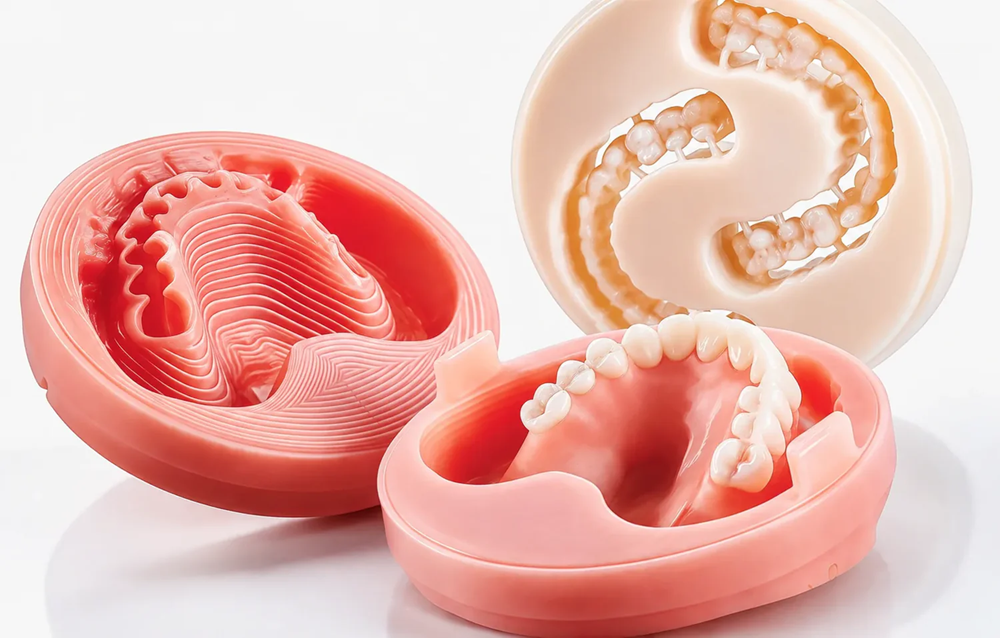
Monocolor denture disc
DENTURE WITH BICOLOR DISC
This method involves milling the entire denture (teeth and base integrated or monolithically transitioned) from a single multi-layered disc featuring pre-bladed shade transitions from cervical to incisal/occlusal.
-
PROS:
-
High Efficiency & Speed: Drastically cuts down lab processing time, eliminates the bonding/gluing step, and streamlines the digital workflow.
-
No Delamination Risk: Since the teeth and base are milled as a single contiguous unit (or monolithic structure), there is zero risk of debonding between the teeth and the base material.
-
Cost-Effective: Reduces material waste and labor hours, making it an attractive option for budget-conscious cases.
-
CONS:
-
Limited Aesthetic Customization: Shade transitions are fixed by the disc manufacturer’s gradient, making it difficult to customize individual tooth shapes, rotations, or severe shade deviations.
-
Bulky Transitions: The interface between the “tooth” layer and the “pink gum” layer can sometimes look artificial or abrupt if the nesting isn’t meticulously planned for the specific patient’s vertical dimension.
